
ITSM without additional cost has ceased to be merely a competitive differentiator and has become a strategic necessity for companies that wish to grow with financial predictability and technological maturity.
For years, the IT Service Management market was structured under a modular model. Organizations contracted a base solution and, as operations evolved, new features were activated at additional cost. The logic seemed natural: pay as you go. However, with the acceleration of digital transformation and the incorporation of artificial intelligence into corporate routines, this model began to generate significant distortions.
Today, the question CIOs and CFOs need to ask is not just which platform to choose, but which model supports operational growth without compromising budget predictability.
It is in this context that HaloITSM, officially supplied in Brazil and Latin America by T4IT, introduces a structural change in the market.
The structural problem of the traditional modular model
Most traditional ITSM platforms operate with a module-based structure. The company contracts the core solution and, as new needs arise, activates additional functionalities at additional cost.
In practice, this means:
- Chatbot as an additional feature with usage-based pricing.
- Advanced automation features are charged separately.
- Artificial intelligence as a premium add-on
- More sophisticated integrations linked to higher-level plans.
- Charging based on AI consumption or token.
The problem isn't the existence of extra features. The problem is the financial penalty for upgrading.
When every advancement requires contract renegotiation or increased licensing, it creates an environment where innovation needs to be financially justified even before it is operationally validated. This scenario generates internal friction between technology and finance.
The more a company matures, the more expensive it becomes to evolve.
This is the paradox that many organizations face.
Artificial intelligence has changed the equation.
Just a few years ago, artificial intelligence was seen as a competitive advantage. Today, it's a basic requirement.
Companies expect their ITSM platform to offer:
- Automatic call classification
- Intelligent response suggestions
- Predictive incident analysis
- Automation of complex workflows
- Integration with language models
However, in most solutions on the market, these features are still treated as paid add-ons.
This creates a contradictory scenario: the company recognizes the strategic value of AI, but hesitates to expand it due to the variable financial impact.
The adoption of AI will depend on the budget, not the strategy.
This is precisely where the concept of ITSM without additional cost becomes crucial.
ITSM at no additional cost as a competitive advantage.
When we talk about ITSM without additional cost, we are talking about a paradigm shift.
HaloITSM was designed as an integrated platform, not as a set of separately marketed modules. This means that enabling features within the solution's architecture itself does not automatically trigger new licensing costs.
In practice, this offers three strategic benefits:
1. Budgetary predictability
The company knows exactly what its investment structure will be.
2. Freedom to evolve
New features can be activated as the operation matures, without fear of unexpected financial impact.
3. Sustainable scalability
Growth is not penalized contractually.
This model profoundly alters the relationship between technology and finance within the organization.
The importance of predictability for CIOs and CFOs.
In complex corporate environments, the technology area already operates under multiple pressures: security, compliance, cloud, digital transformation, and continuous innovation. When ITSM becomes an unstable financial variable, it starts to be seen as a risk.
The traditional model generates a cost curve that increases proportionally to the expansion of operations. The HaloITSM model, however, stabilizes this curve.
This allows:
- More consistent multi-year planning
- Better ROI control
- Reducing contract revisions
- Greater alignment between IT and finance.
Predictability is not just an administrative advantage. It's a strategic factor.
HaloITSM as an orchestrating platform
Another essential point is understanding that modern ITSM goes beyond call management.
Mature companies use their platform to:
Internal support (IT, HR, Facilities, Legal)
In organizations that reach greater operational maturity, the concept of a service desk evolves into Enterprise Service Management (ESM) . The platform then serves different corporate areas with structured workflows, defined SLAs, and complete traceability.
External customer service
The platform's maturity also allows for expanding its use to end- customer service . In this scenario, ITSM ceases to be just an internal tool and becomes integrated into the customer experience.
Integration with CRM
Integration with CRM represents a qualitative leap in relationship management. Instead of maintaining isolated systems, one for support and another for commercial relationships, the company connects operational data with strategic data.
Orchestration of financial processes
Operational maturity also leads to integration with financial flows. Payment approval, contract control, supplier management, invoice validation, and internal requests can all be structured within the platform.
Cross-functional automation
Cross-functional automation means that workflows are not limited to a single department. The platform now allows for automations that span multiple areas of the organization.
When each new area requires additional hiring, expansion becomes slow and costly.
HaloITSM acts as an orchestrating layer, allowing multiple streams to operate within the same technological ecosystem. This centralization reduces technical complexity, eliminates redundancies, and improves data quality.
Governance, LGPD (Brazilian General Data Protection Law), and operational maturity.
Automation and AI projects often face resistance due to issues related to governance and data protection.
By centralizing processes within an integrated platform, the company gains:
- Traceability
- Access control
- Structured audit
- LGPD Compliance
- Information security
Intelligence ceases to be an improvised layer and begins to operate within a controlled, structured, and auditable environment. This approach is fundamental within an ITSM model without additional costs , as it allows innovation to evolve without compromising governance, security, or financial predictability. This combination of innovation and governance is one of the pillars that support the HaloITSM model.
Strategic comparison: traditional model vs integrated model
The structural difference can be summarized as follows:
| Traditional model | HaloITSM Model |
| Growth linked to new paid modules. | integrated platform |
| AI marketed separately | Native AI |
| Unpredictable variable costs | Predictable growth |
| Dependence on multiple contracts | Stable contractual structure |
This difference isn't just commercial. It directly impacts the speed of the organization's digital transformation.
The strategic role of T4IT in Brazil and Latin America
Adopting a robust platform requires implementation expertise.
T4IT, with over 12 years of experience in technology and recognized for its expertise in strategic digital positioning, has been operating as a distributor and technical competence center for Halo in Brazil and Latin America since 2023. With a consolidated ecosystem of business partners and clients throughout the region, we reinforce our position as key players in the transformation of the ITSM market.
We operate in:
- Migration of modular platforms
- Structuring complex operations
- Intelligent automation implementation
- Consolidation of internal and external customer service.
- Expansion into new segments such as agriculture, retail, and e-commerce.
By consolidating a growing base of large clients, T4IT demonstrates that the market is ready for a more sustainable model.
Cost reduction in IT doesn't mean cutting investment.
There is a significant difference between cutting costs and optimizing costs.
The ITSM model with no additional cost does not propose scope reduction, but rather the elimination of structural inefficiencies.
By unifying multiple functions within a single platform, the organization reduces:
- Redundant tools
- Fragile integrations
- Parallel contracts
- Hidden maintenance costs
The result is a leaner and more financially controllable operation.
The future of ITSM: integrated intelligence and financial sustainability.
The market is heading towards a scenario where two factors will be decisive:
- Embedded intelligence as standard
- Financial sustainability of the contractual model
Platforms that rely on constant modular expansion may face increasing resistance as financial sectors demand greater predictability.
On the other hand, solutions that offer ITSM at no additional cost tend to become established as a structural foundation for organizations that want to grow with control.
Why this debate is strategic now.
Many companies implemented their current platforms before the explosion of artificial intelligence and before the acceleration of post-pandemic digital transformation. As maturity increases, contractual limitations emerge that were not evident at the beginning.
Revising the ITSM model is now part of the strategic agenda.
The central question ceases to be technical and becomes structural:
Does your current model encourage or hinder the evolution of your operation?
If every technological advancement implies an unforeseen increase in cost, perhaps it's time to reassess the foundation of your platform.
Model matters more than functionality.
Today, many platforms offer similar features in terms of automation, service catalog, and SLA management. What truly differentiates the solutions is the model that underpins their evolution.
The concept of ITSM without additional cost represents a structural change in how companies approach service management.
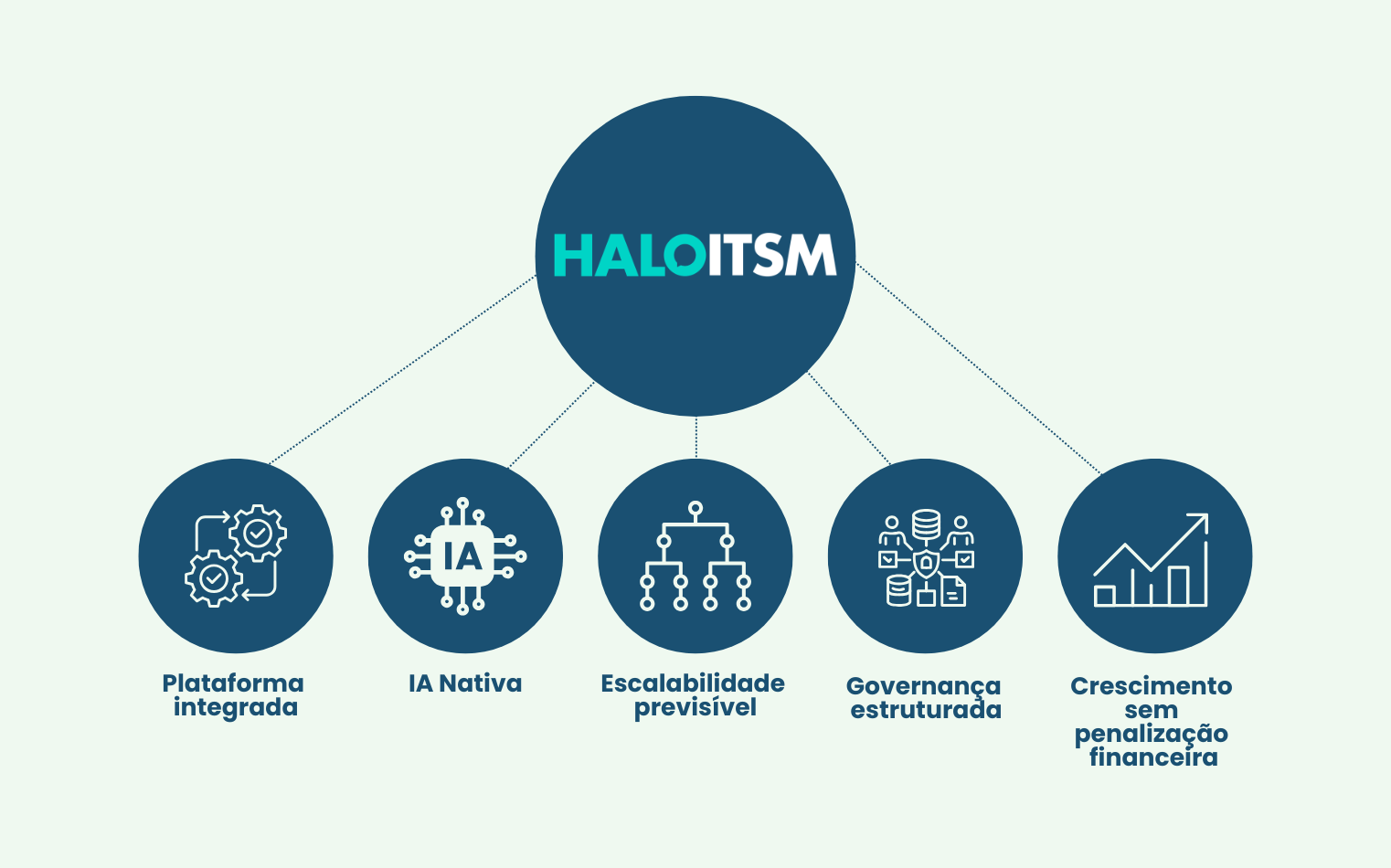
HaloITSM offers:
In a market where efficiency and budget control are permanent priorities, this approach ceases to be optional and becomes strategic.
Want to understand how to implement ITSM without additional cost in your organization?
T4IT is prepared to conduct an executive analysis of your current structure and demonstrate how HaloITSM can:
- Eliminate hidden costs
- Reduce reliance on paid modules.
- Incorporate AI without variable financial impact.
- Structuring governance and compliance
- Sustaining growth with predictability
If your organization seeks technological maturity without compromising financial control, now is the time to reassess your ITSM model.
Contact T4IT and schedule a strategic presentation.
The future of ITSM isn't just in technology.
It is in the model that supports ITSM at no additional cost.
Follow us on LinkedIn and stay up-to-date on ITSM trends at no additional cost that are shaping the future of enterprise IT.